No, K-Pop is not Motown reskinned.
The same old debate over K-Pop’s origins has been raging on social media yet again and I’d like to take this time to say it definitively:
No, K-Pop did not come directly from Motown.
I’ve loved Motown since I was a kid and listening to a drug store cassette of Motown hits on my walkman. And the Motown legend is truly impressive. Berry Gordy with $800 borrowed from family and a vision of assembly-line hits that could cross over to mainstream (white) radio to make money. He had a crack team of songwriters (Holland-Dozier-Holland), a phenomenal in-house band, and a stable of talented young performers.
But the Motown story is not the K-Pop story.
“K-Pop” as we know it today comes from a few different cultural influences.
1. Johnny Kitagawa and “Johnny’s & Associates” (now STARTO).
This one is huge and is obvious if you have even a passing familiarity with 1980s Japanese pop culture.
Here is one of the earliest K-Pop boy groups, Sobangcha, in 1988:
And Johnny’s & Associates group Shonentai with their 1986 hit “Diamond Eyes”:
Even if you track the origins of modern K-Pop only back as far as Lee Soo Man’s SM Entertainment and H.O.T., in my opinion (in which I am not alone) the group was pretty obviously modeled after Johnny’s & Associates flagship group SMAP.
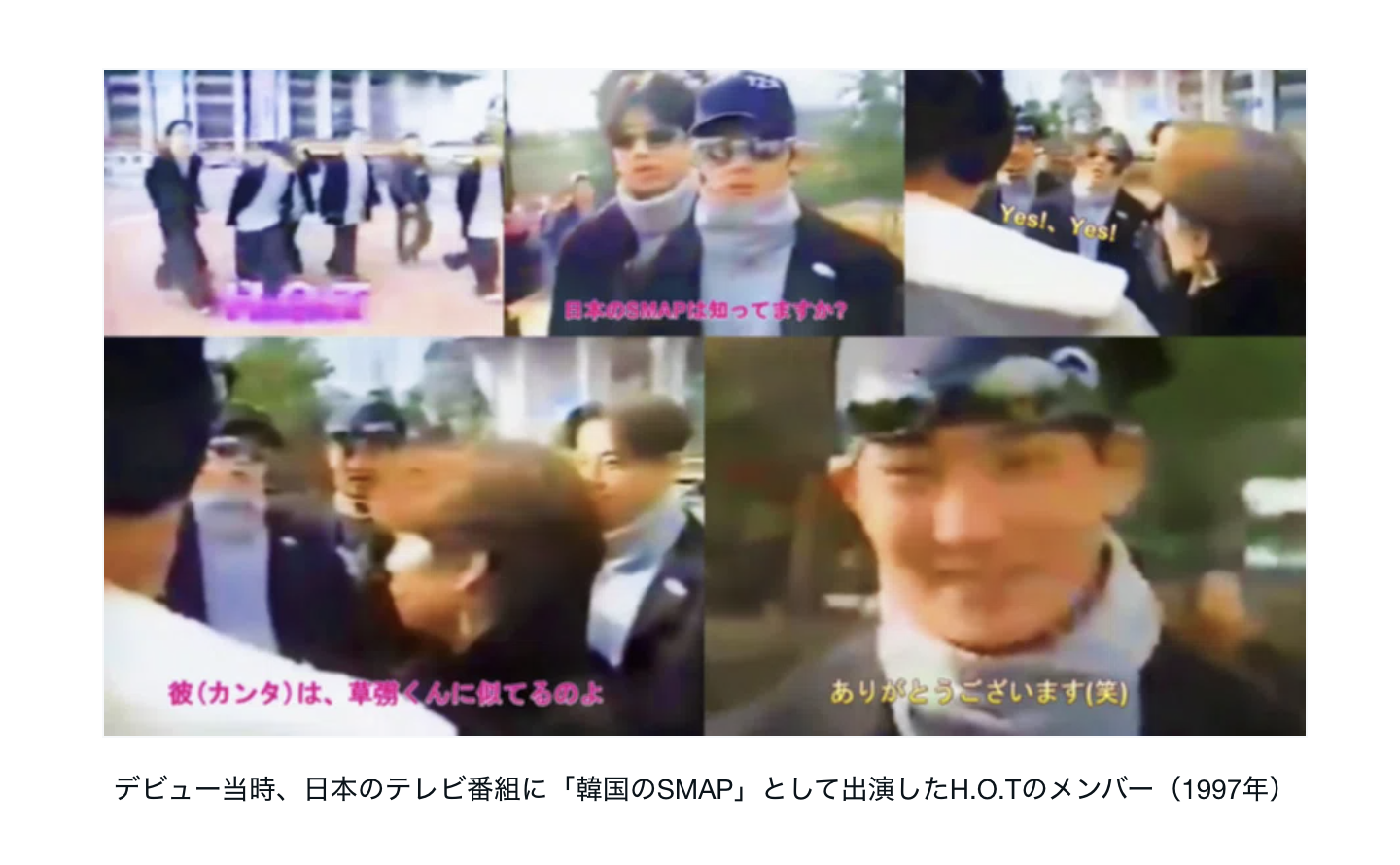
(Image of debut era H.O.T. being introduced as Korea’s SMAP on a Japanese television program.)
You can also trace this influence pretty directly for a couple of other foundational SM groups:
V6 -> Shinhwa
Arashi -> SHINee (these two groups shared a significant overlap in global fandom in the late 2000s and early 2010s with comparisons between Ohno/Onew, etc. etc. being very common around sites like LiveJournal)
2. Club Moonlight and the Korean-American diaspora based in Los Angeles
This is one I’ve spent a lot of time on. In my opinion, the primary vector for the introduction of the hip-hop sound into contemporary K-Pop is the small cluster of Korean-American returnees from Los Angeles (and their fellow travelers, like Perry) who injected their taste in hip-hop into YG Entertainment, which led pretty directly to the career of guys like the (half of an EGOT-winning) Teddy Park from 1TYM.
Club Moonlight was another important element here as a gathering place where these early K-Pop artists met and mingled with Black soldiers posted to Seoul with the American military. (You can read a bit more on that scene here.) It’s important to note that Seo Taiji, whom many post-BTS stans claim as the father of K-Pop, was not a part of this early hip-hop scene in Seoul and only came to it later via Yang Hyun-Suk.
Later on the hip-hop influence from the Berklee guys like Psy and Cho PD would also play a role but neither of them were on the ground idol guys. They both entered later. (You can listen to that story here.)
3. Maurice Starr and Lou Pearlman
Maurice Starr was the boy band impresario who took first New Edition and then their white counterparts New Kids on the Block to fame… while (allegedly, reportedly) pocketing the fortune.
Lou Pearlman did the same with Backstreet Boys, *NSYNC, O-Town, LFO, etc. etc.
The training model that Lee Soo Man eventually emerged with borrowed from both of these guys, along with elements of the idol trainee model from Japan.
If we take that H.O.T. was positioned as the Korean SMAP, then TVXQ a few years later was positioned as the Korean *NSYNC.
Here they are doing *NSYNC’s a capella arrangement of “O Holy Night” at debut:
One could (and people did at the time) make the argument that both Maurice and Lou were trying to capture that Motown magic—or more specifically, that Berry Gordy Midas Touch.
So, in a very roundabout way, if we take that Lou Pearlman was trying to be the “Berry Gordy of teen pop” then some elements of Motown did make their way into K-Pop today.
But that is not the argument being made on stan twitter.
4. Korean Government Soft Power initiatives.
This is one that the stans don’t like to acknowledge but it’s there and absolutely affects the type of and quality of (musical and other) product being released, supported, and (globally) promoted. Berry Gordy very much did not have the support of the Federal Government (and may have had other, less savory, alleged, financial ties.)
The TL;DR is that it’s extremely reductive to claim a direct through line from Motown to today’s K-Pop. While there are definitely elements of Motown artists and training that were transmitted down—especially from Michael Jackson, who remains a massive inspiration to artists like Taemin—K-Pop evolved from a number of disparate sources and has become its own very unique musical ecosystem.