The Potemkin Idols
Last year, in anticipation of the return of BTS #discourse, I wrote a post titled “BTS is a Mirage” covering the beginnings of BigHit Entertainment and BTS, which has quickly become one of my most popular posts. BTS is a mirage. There’s a feeling of cognitive dissonance when you try to bring the group and the content they create into focus. Like one of those old magic eye pictures, it can be headache inducing to attempt it.
BTS has managed to skate by on the knife’s edge of this cognitive dissonance for years because—despite being assigned the label of the “biggest K-Pop act” or even “the biggest band in the world” by fans and the media—most normies were not actually paying attention. They just accepted the hype at face value. But on Saturday, this facade came crashing down and the Potemkin Idols were exposed.
I’ve seen popular boy groups return from military service before but I’d never seen anything like the media hype for the BTS comeback and I was in Korea when G-Dragon was discharged from the Army. The New York Times dedicated an entire news vertical to it; a media blitz went out across the English language entertainment sphere featuring bold-faced names like Diplo, Ryan Tedder, Max Martin, Netflix, Super Bowl, Hamish Hamilton. The public was blitzed with mysterious ads asking what our love song was and were told 260,000 fans were going to flock to Gyeongbokgung in the heart of Seoul to see BTS perform in a triumphant comeback that would have them walking the kings’ path in a figurative coronation streamed globally to hundreds of millions of fans worldwide on Netflix.

(Dedicated coverage at The New York Times.)
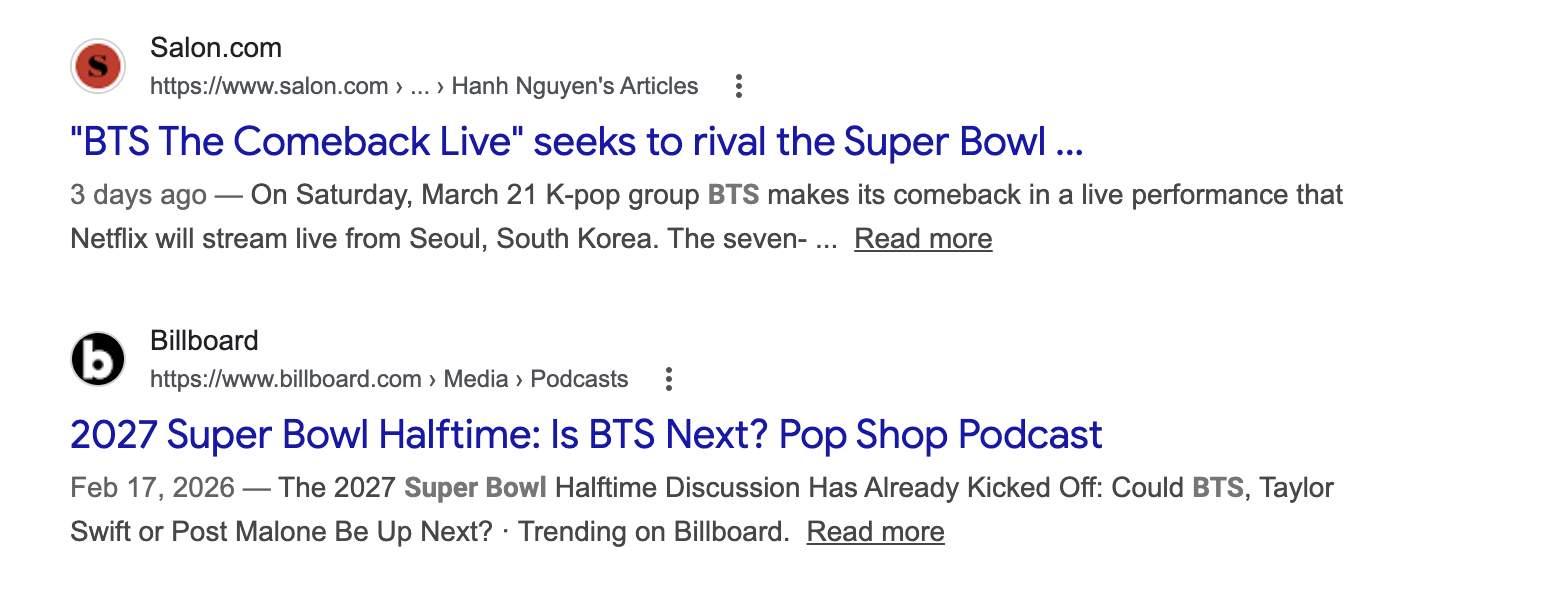
(Use of bold faced names to generate even more hype)
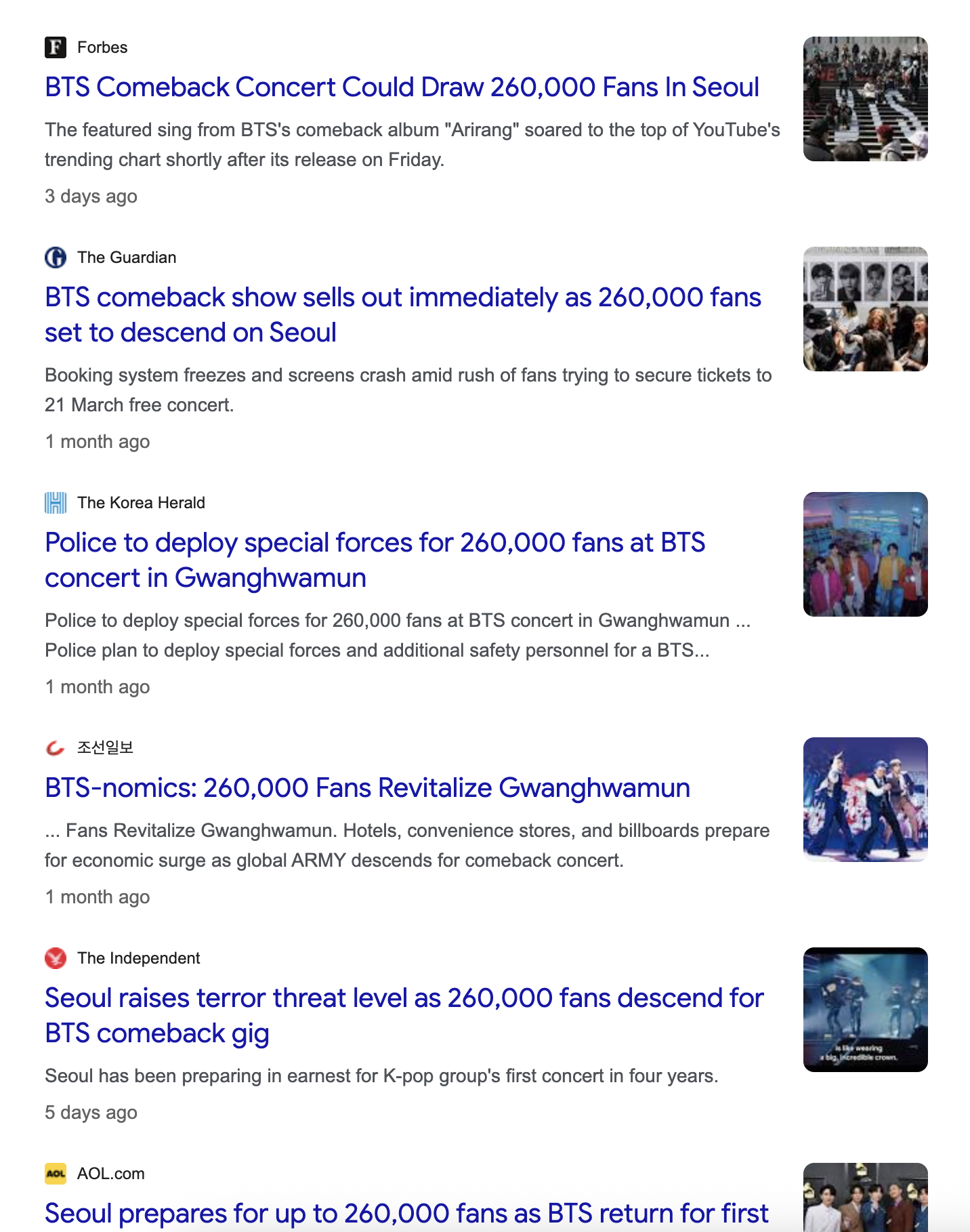
(The number of 260,000 fans was heavily promoted.)
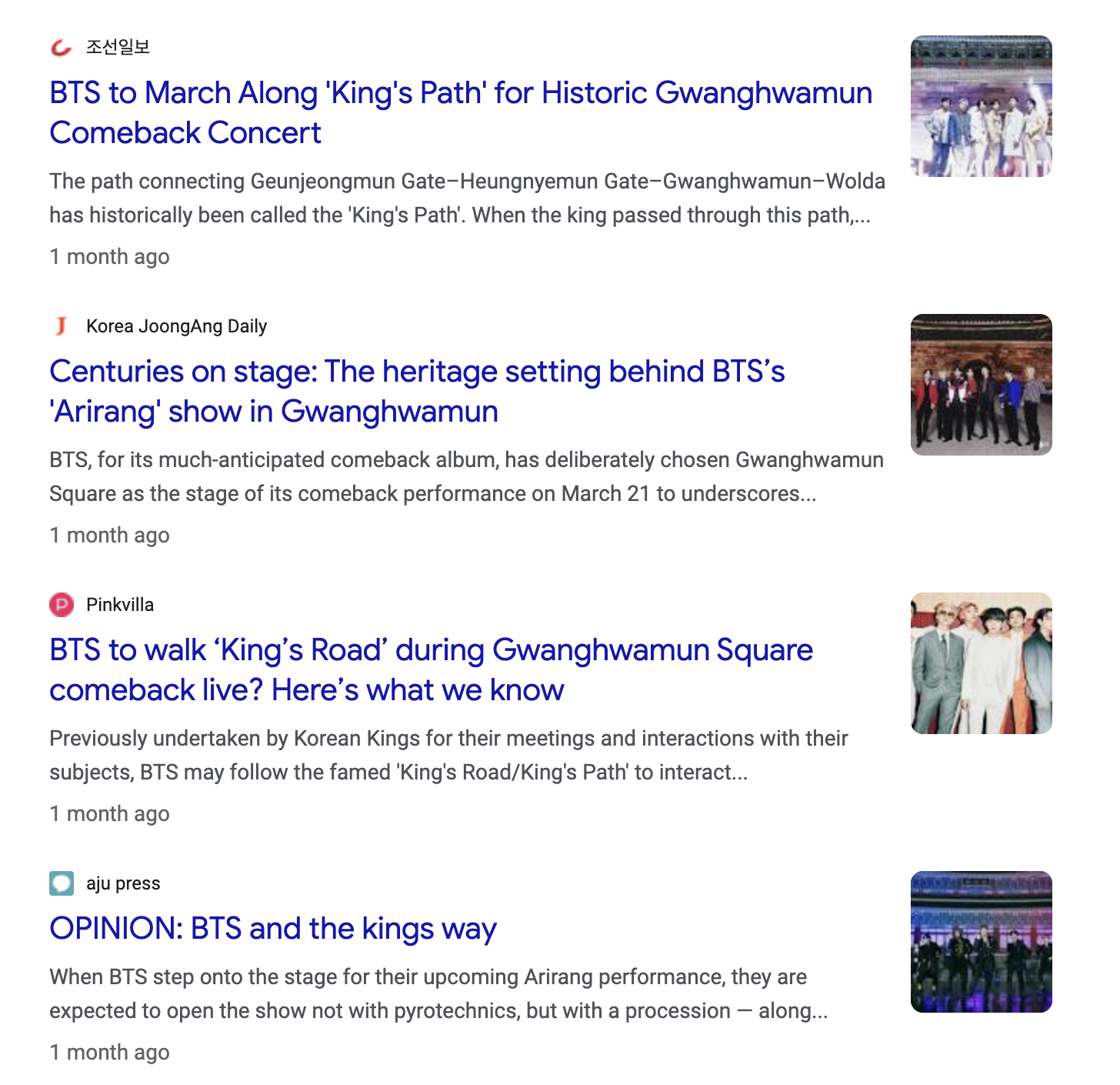
(“The King’s Path” was also used in promotions.)
It was going to be Wyld Stallions but real.
We also saw the government get involved with the president even tweeting in support of the concert and the prime minister dropping by the airport to check on all those fans (reportedly) flocking to Seoul for the concert. Freelancers working the K-Pop beat feasted on the hysteria. Here’s a Seoul-based freelancer in the Guardian in an article dated March 18, 2026, that captures the tone of coverage we were seeing:
Up to 260,000 people are expected in the area, a crowd size similar to the mass protests that filled the same square during the 2016 presidential impeachment crisis of then-president Park Geun-hye.
Some 22,000 free tickets were made available, but most attendees are expected to gather in surrounding streets without tickets, where an array of fan events will take place.
The Seoul police agency will deploy 6,500 officers, including more than 70 riot police units, on the day. Seoul city government will deploy a further 3,400 personnel, with 102 fire trucks and 803 firefighters positioned around the concert site. Subway trains will bypass stations that are close to the event.
The venue will be managed as a stadium-style operation, with 31 entry gates each fitted with walk-through metal detectors. Authorities have also banned civilian firearm withdrawals from police stations across Seoul.
Special forces units will be pre-positioned around the venue, while vehicle barriers, including iron spike strips and police buses, will secure the perimeter. Access to and rooftop use of 31 surrounding buildings will be restricted on the day.
And then the album was released.
And then the concert happened.
And then BTS slunk off quietly to New York City with a half-baked apology to Seoul from Hybe and another one from RM.
The 260,000 fans had been a fantasy; just like BTS has become a fantasy. Anybody following along live during the day of the concert would have witnessed the narrative collapsing in real time as the Seoul public realized their lives had been disrupted and tax dollars spent on an idol concert that could have and should have taken place in a stadium, just like every other idol concert, because that’s exactly what this performance was: an idol concert, and a bland one at that.
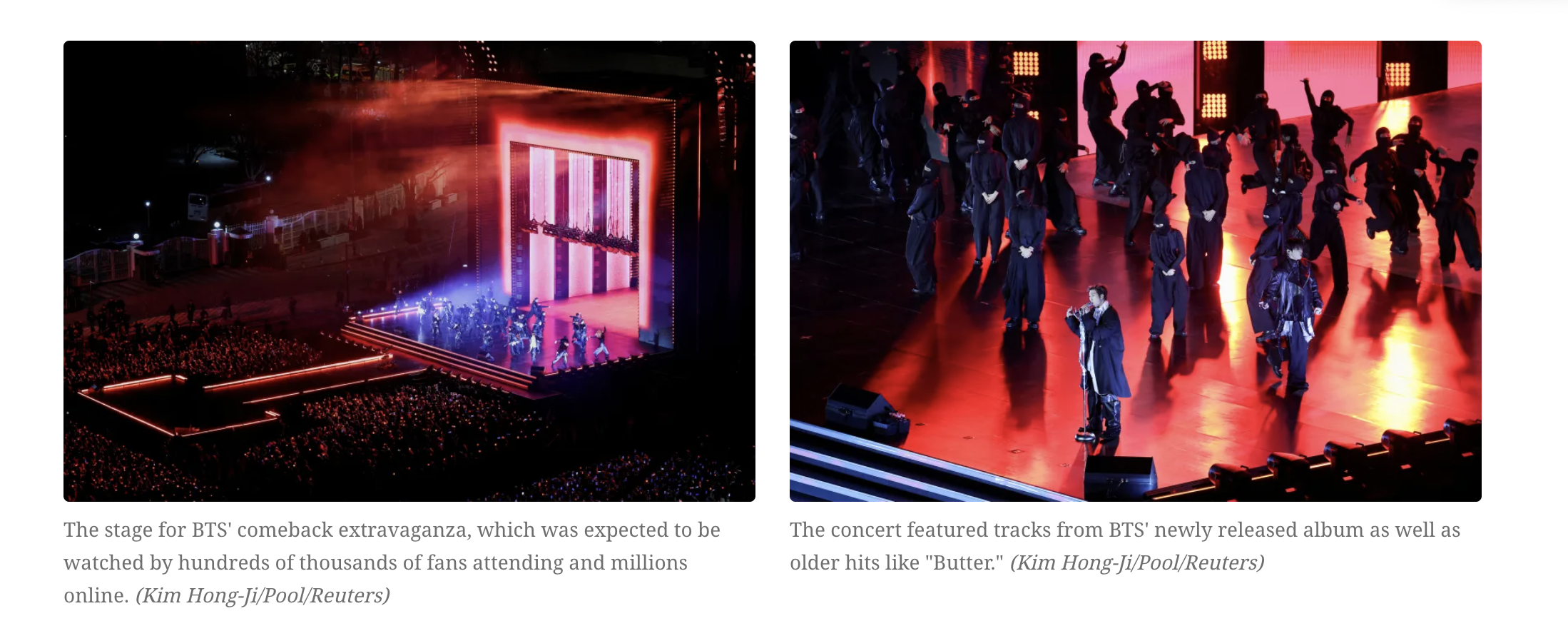
(Images from a CNN article)
There was no live band; the singing was very heavily processed if not lipsynced; and the performances themselves (from what video I saw online) were nothing out of the ordinary for an idol stage and far less charming than some of the rookie stage acts you’d see on Music Bank let alone some of the other reunion stages we’ve seen in the past few years like 2PM, Block B, or domestic powerhouses Winner. BTS had shut down the city to essentially film a plodding idol stage in front of Gyeongbokgung (which was barely visible in most images) and between 16-22k ticketed fans, 15k security, and a number of lookie-loos that fluctuated depending on which outlet you were reading and how friendly that outlet was to BTS’s parent company, Hybe. The negative reaction was swift and brutal—most notably with Hybe stock prices dropping sharply as soon as the markets opened.
Finally, the truth that my long-time readers should all know has hit the mainstream: Bang took what had originally been a perfectly fine, middle of the pack, third generation boyband à la Boys Republic, Uniq, or ToppDogg and transformed them via the media into the Heirs of Seo Taiji and the Saviors of K-Pop who Paved the Way for Korean Culture worldwide. And he accomplished this transformation using songs that were essentially the musical equivalent of the ending theme song to Trolls at best and unlistenable at worst.
Using shadow puppets, string, paint, some cardboard, and fans willing to bot stream and bulk purchase mp3s, the legacy media and tech platforms like Spotify and Netflix were more than happy to help build and support the Potemkin Idols. As long as one didn’t look too closely at the facade, it was fine. But Hybe forgot that the key part of building a Potemkin village is that you can’t actually take your shareholders on a nuts and bolts tour…because there is no there there.
The evidence that there was nothing behind the facade had been building for years. Anybody with ears could have heard the deterioration of the quality of their musical output and of their vocal skills. Despite the puffed up reviews from willing outlets like Billboard, Rolling Stone, and the NME, nobody outside the core fandom demographic really seemed to care—either in the West or in Korea—because they didn’t need to. The songs outside of one or two bubblegum kidsbop hits never escaped fandom containment despite millions of fan streams. Everything existed inside of a very large bubble.
The ironic thing is that Hybe themselves ended up bursting the bubble. If they had held a massive comeback event for BTS in a stadium, rather than expose all of Seoul to the Potemkin Idols, I don’t think people would have actually looked closely enough to see the ragged edges of the cardboard cutouts.
There have been a couple of excellent reviews of Arirang from Korean outlets that I’ll link here: from IZM and from Zenerate. Both reviews capture that feeling of cognitive dissonance between the media hype and the product. From what I’ve heard of the album, it sounds surprisingly amateurish for all the talent that they gathered to work on it. The title track is lifeless and the rap sounds a lot more like rookie Soundcloud rappers over expensive purchased beats than the triumphant return of the (alleged) Kings of K-Pop. And the vocals is so overly processed that I wouldn’t be shocked to find that large swathes of the vocals were done using AI, which—in a huge coincidence—BTS’s parent company Hybe has heavily invested in.
A cynical observer may wonder if this Seoul concert had been a Hail Mary Pass. After a year plus of lawsuits and bad press and arrests, maybe it was an attempt to prove the company was Too Big To Fail. Or maybe an attempt to overwrite in public memory the lightstick-filled protests of 2024-25, which saw hundreds of thousands of people pour into the streets of downtown Seoul and generated images like this:
Or maybe they just forgot that while one person buying 100 albums is the same as 100 people buying 1 album each on paper, it’s still only one person in Gwanghwamun Square.