For anyone who has been offline for the past few days, the big news in K-Pop circles is that The New York Times published an exposé on NewJeans’s draconian contracts. Those of us who have been around a while were not shocked that—like many, many K-Pop companies before them—Hybe had apparently attempted to lock their idols down in highly controlled contracts.
Without rewinding to the beginning of time as we know it, I covered some of the K-Pop contract history while exploring the breakup of five-member TVXQ, but the TL;DR is that back in the 1980s and early 1990s, K-Pop contracts were short because companies thought the shelf life on teen pop singers was short. This early gayo (retroactively called first generation K-Pop) was considered disposable music for teenagers and is why very popular boy group Sechs Kies disbanded in 2000 despite still being very popular—because they could disband. Through examples like Sechs Kies and, especially, the breakup of H.O.T. when they were still extremely popular, the contract pendulum swung in the other direction giving us the infamous 13-year “slave contracts” of TVXQ and then it swung back after that blew up leading to the creation of a standard contract template for K-Pop acts.
This contract template doesn’t mean that contract disputes have ended. Some K-Pop idols (and entire groups) have tried to get better terms for themselves/leave allegedly exploitative contracts over the years including KARA and BAP, as well as Block B, who managed to successfully leave their contract as a group and form their own company (now home to Ateez).
So with all that history in mind, the response to the NewJeans contract exposé has been fascinating.
The Dark Side of K-Pop
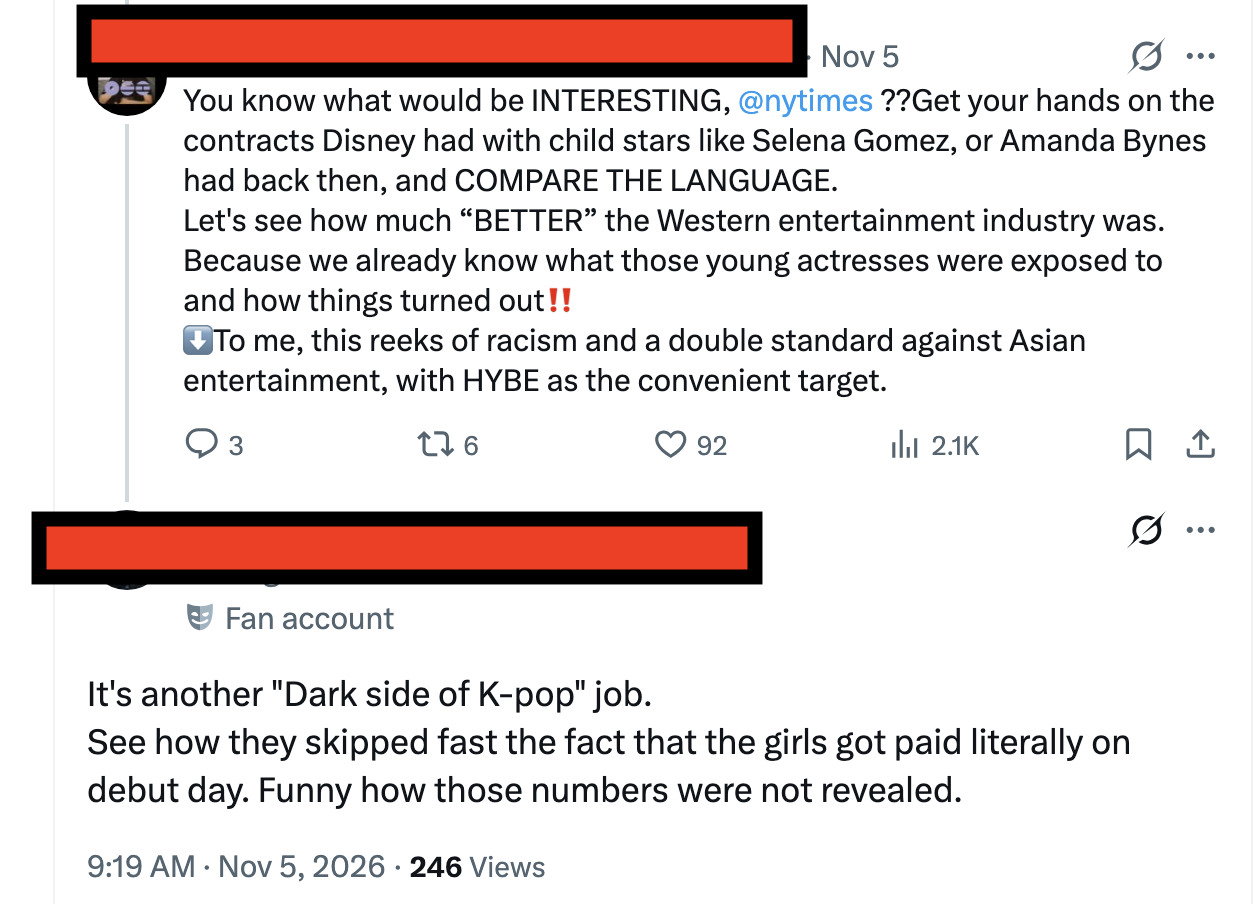
The least helpful lens for looking at what happened to NewJeans is, unfortunately, Western media’s favorite one: THE DARK SIDE OF K-POP. We’ve been there and done that to infinity. Here’s the Los Angeles Times in 2009 as part of a broader article on K-Pop Darkness:
The governmental Fair Trade Commission met in July to investigate the “slave contract” phenomena after three members of the now-disbanded male pop-idol group called TVXQ filed a lawsuit to end a 13-year exclusive contract with their manager. The panel ruled that the management’s contract was illegal and suggested an ongoing problem in the industry.
THE DARK SIDE OF K-POP is unhelpful because it’s presented with neither context nor nuance. As I’ve said in my response to the BBC documentary on Burning Sun, it turns serious issues into salacious clickbait for foreign audiences to consume while feeling morally superior. The typical pushback on THE DARK SIDE from fans is that the Western entertainment industries have similar (or worse!) issues that go unremarked on.
The New York Times article does flirt with the DARK SIDE framing—mentioning famous idol suicides, etc.—but to its credit does also mention the exploitative contracts of American artists, even if it implies those are no longer widely used.(1) The article even quotes a Korean industry expert who specifies that the NewJeans contracts appeared to be “unusually aggressive” even within K-Pop [emphasis added]:
“This contract is unusually aggressive,” said Jong-eon Roh, a Seoul-based entertainment lawyer who was one of five experts who reviewed the NewJeans deal for The Times. “It restricts the artists’ freedom to a degree rarely seen, even in recent major-label contracts.”
Stop Wasting BTS’s Money
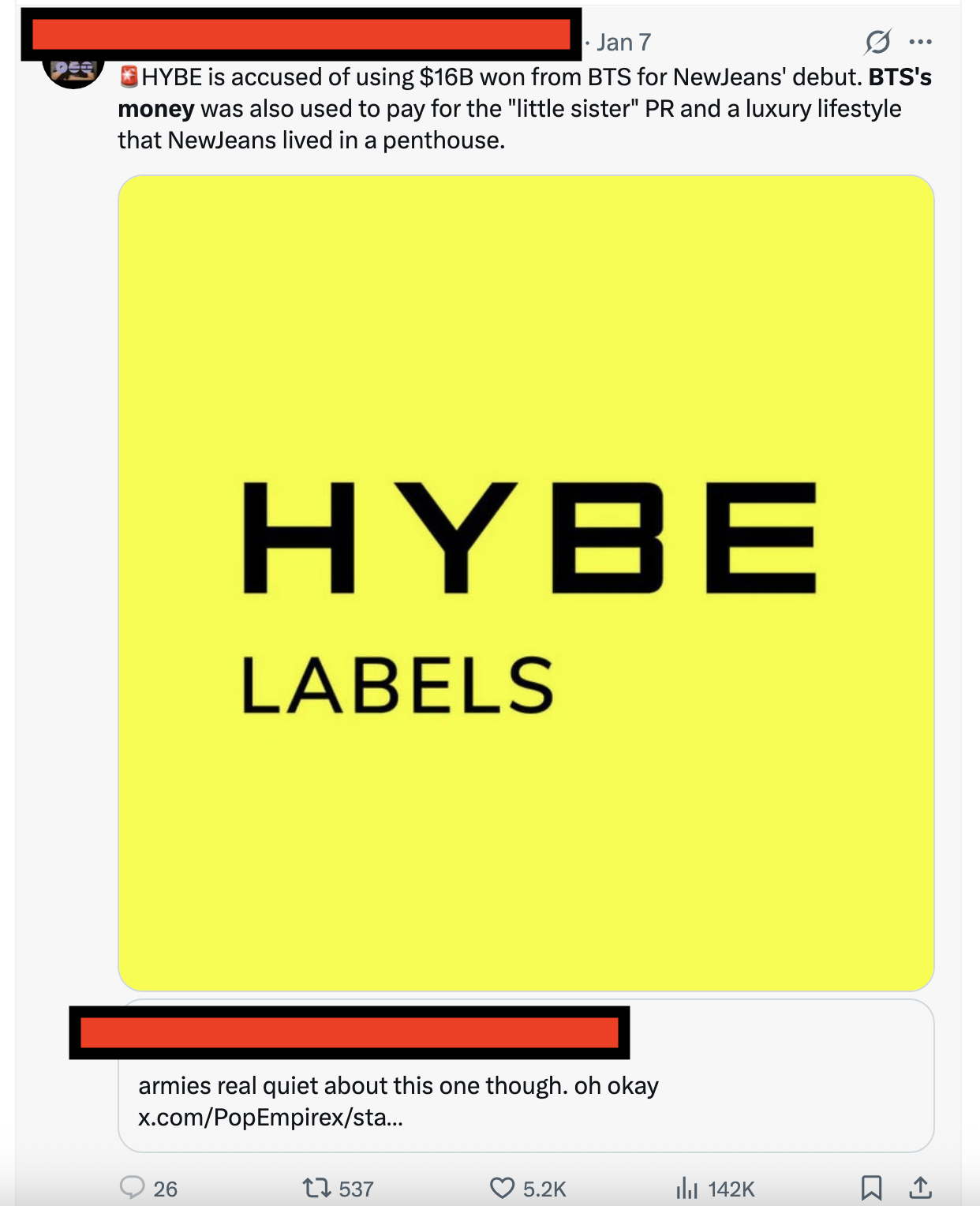
Company Stans have always existed and will continue to exist. Stans like the things they like and don’t want any interruption to the supply of the thing they like, even if it means refusing to believe that their favorite idol is unhappy with his or her situation or being mistreated. Idols who go against the company and risk splitting up a beloved idol group will always be divisive to a certain segment of the fandom. It’s inevitable. That being said, what I find interesting about the NewJeans case is that, by and large, it's not NewJeans fans who are mad at the members for not delivering them more NewJeans product.
Without recounting the entire history of Hybe, the pertinent information here is that Bang Shi-Hyuk brought on former (and controversial) SM Entertainment visual director Min Hee Jin to then-BigHit Entertainment in July 2019 to direct their branding and to launch a new girl group for the company. At this point, then-BigHit Entertainment’s only major act was BTS and while they’d just launched a younger boy group, Tomorrow X Together, to actually capitalize on the BTS boom and grow the company, they’d need more than just the two boy groups.(2)
To fully understand the BTS’s Money fan, it’s important to understand that when many of these fans were onboarded to K-Pop, BigHit Entertainment was essentially just BTS and due, in part, to the methods that BigHit used to build BTS’s fandom through things like the encouragement of crowd funding mp3 purchases, BTS fans felt a real ownership over BTS’s success and over the money that they brought in to the company. To this day, you will see reference to “BTS’s money” from fans who don’t like to see company resources being used to do things in the interest of parent company Hybe (then BigHit Entertainment) rather than specifically for BTS.
This includes resources being used to debut new acts.
Complaints about companies pivoting to new acts and “basementing” a beloved fave have been around as long as K-Pop has been around. Here is an anonymous commenter under a 2012 blog post titled: EXO SHOWS US WHAT’S WRONG WITH K-POP [emphasis added]:
Hi, I don't want to bash you...just a correction. TVXQ was popular right from debut. TVXQ did win one of those music show awards for Hug and received a newcomer award the "year" they debuted. I say "year" because they debuted 12/26/03 and formally started activities in the year 2004. EXO, on the other hand, won year-end awards but did not win their first music show award until Wolf...after being heavily promoted. Suju on the other hand, was overshadowed by TVXQ until they broke up. Also, the popularity EXO is experienced after MAMA is normal for a SM artist. Any artist that debuts under SM will always shine with an already biased fan base---much like YG diehards have for their YG fam bam. I am a fan of both EXO and TVXQ but just want to straighten out facts. Also, they are being compared because EXO is getting SM's style that TVXQ popularized...all of my TVXQ friends are upset that EXO is using that style...but in the end...it's not TVXQ's style but a style of SM.
EXO eventually found their own style and fandom and then were “basemented” in favor of a younger boy group and the cycle continues.
After TXT’s debut in 2019, Enhypen’s debut in 2020 (only about 18 months later) fueled competition between the two groups' fans. This comment from Reddit captures what I observed among fans at the time [emphasis added]:
During debut, it was BTS. Everything they did was connected back to BTS. This is the reason TXT has so much hate and discrediting (much of it actually from Engenes and other 4th Gen BG fandoms) because Bighit refused to let them to do anything without connecting them in name back to their seniors. Also while they were rookies, they weren’t allowed to be apart of a single collab stage with their peers. Not one. Then Enhypen debuts and suddenly it feels like TXT are babysitting these rookies when they should be growing and making a name for themselves. Their first collab stage is with Enhypen, they do these variety shows with Enhypen, and their first documentary is with Enhypen. MOAs don’t like how TXT is always attached to someone else. It’s BTS’ little brothers or it’s TXT and Enhypen like they’re twins or one big group. MOAs want TXT to be known as themselves and only themselves.
So yeah, it’s less to do with Enhypen and more to do with the fact Bighit/Hybe won’t stop shoving the family agenda down our throats. It also doesn’t help that Engenes connect everything their favs achieve back to “being better than” TXT and are really shady towards them. On Twitter, it seems Engenes are obsessed with one-upping TXT and MOAs and that created an extra level of discontent amongst MOAs in regards to that group.
The “family agenda” mentioned feels like Hybe trying to massage a more typical K-Pop fandom from the new fans they had on-boarded and, I think, again points back to the issue of the “BTS’s money” fans. To have any sort of longevity and to build a lasting brand, these companies need the fans who will support the “little brothers/sister” groups. Even if idols are no longer assumed to have a shelf life of three years, companies still need new groups. The new generation teens need their own new generation idols. Hybe was running up against the fans who resented “BTS’s money” being used to fund what might potentially be BTS’s replacement or, at the least, BTS’s competition.
When BigHit Entertainment was reorganized into Hybe, one of the alleged benefits was what they referred to as a “multi-label system”, which bundled together multiple “labels” under the single Hybe umbrella. In theory, I think, this was supposed to be a best of both worlds thing—centralize things like accounting and legal, etc. while allowing the “labels” to maximize the product produced and maybe even fuel some competition like how Lou Pearlman had a piece of both the Backstreet Boys and *NSYNC. In theory, I also believe the idea was that this would put a halt to the complaints from the “BTS’s money” fans that, for example, as above, EXO was cannibalizing TVXQ’s resources. In practice to it led to, also as above, complaints from fans that Enhypen were cannibalizing TXT’s resources, despite the fact that TXT were under the Big Hit label and Enhypen were under the Belift Lab label. On paper they were separate labels but in practice they were promoted and received by fans as part of the Hybe family. (This would come back to bite them in butt in a big way when Belift Lab debuted a new girl group with a similar aesthetic to NewJeans on the heels of Ador’s NewJeans.)
The next two groups to debut under Hybe’s multi-label system were Le Sserafim in May 2022, under Source Music (acquired by Hybe in 2019) followed by NewJeans in July 2022 under a new label, Ador, headed by (yes, circling back) the former SM Entertainment visual director Min Hee Jin.
My observation at the time was that the feeling among fans of Hybe label groups, broadly, but of BTS fans, especially, was a feeling of both of these groups as BTS’s little sisters. I suspect that because they were girl groups and not boy groups, the fans wary of funding BTS’s competition did not have their knives out for them.
For me personally, when BTS announced their group activity hiatus on June 15, 2022, I remember feeling quite sad and empty. Then, when NewJeans debuted on July 22, I was really happy. It felt like something fresh and new was beginning just when BTS stepped back. I think that’s why I gave so much affection to them early on. I liked LE SSERAFIM too, but since two of their members were from IZ*ONE while NewJeans were 100% new rookies from HYBE, I felt even more attached to NewJeans.
And when it became clear that NewJeans was being very well received, the feeling from Hybe family fans was overwhelmingly positive. Over the years, Hybe/BigHit had cultivated a fandom that was focused on charts and metrics, so the fact that NewJeans (again, received at the time as BTS’s Little Sisters) were doing very well on the charts was taken very positively by the fandom at large… for the moment.
When is a cookie just a cookie?
Long time idol fans may remember Pedobear, an online meme used to mock people with a sexual interest in children. In K-Pop circles, I remember English language fans referencing Pedobear quite often, especially in relation to idols like Minzy (2NE1), who debuted at 15 years old, Suzy (Miss A--we discussed this in episode 95), who debuted at 15 years old, Krystal (f(x)), who debuted at 14 years old, and Taemin (SHINee)(3), who debuted at 14 years old.
Min Hee Jin worked with both an underaged Taemin and, especially, Krystal while at SM Entertainment and, when NewJeans debuted, some K-Pop fans raised concerns about the young ages of the members in relation to Min Hee Jin’s previous work.
“Choclate Love” was f(x)’s second single. Krystal and Sulli were both around 15 years old. Luna was 16 and Amber was 17.
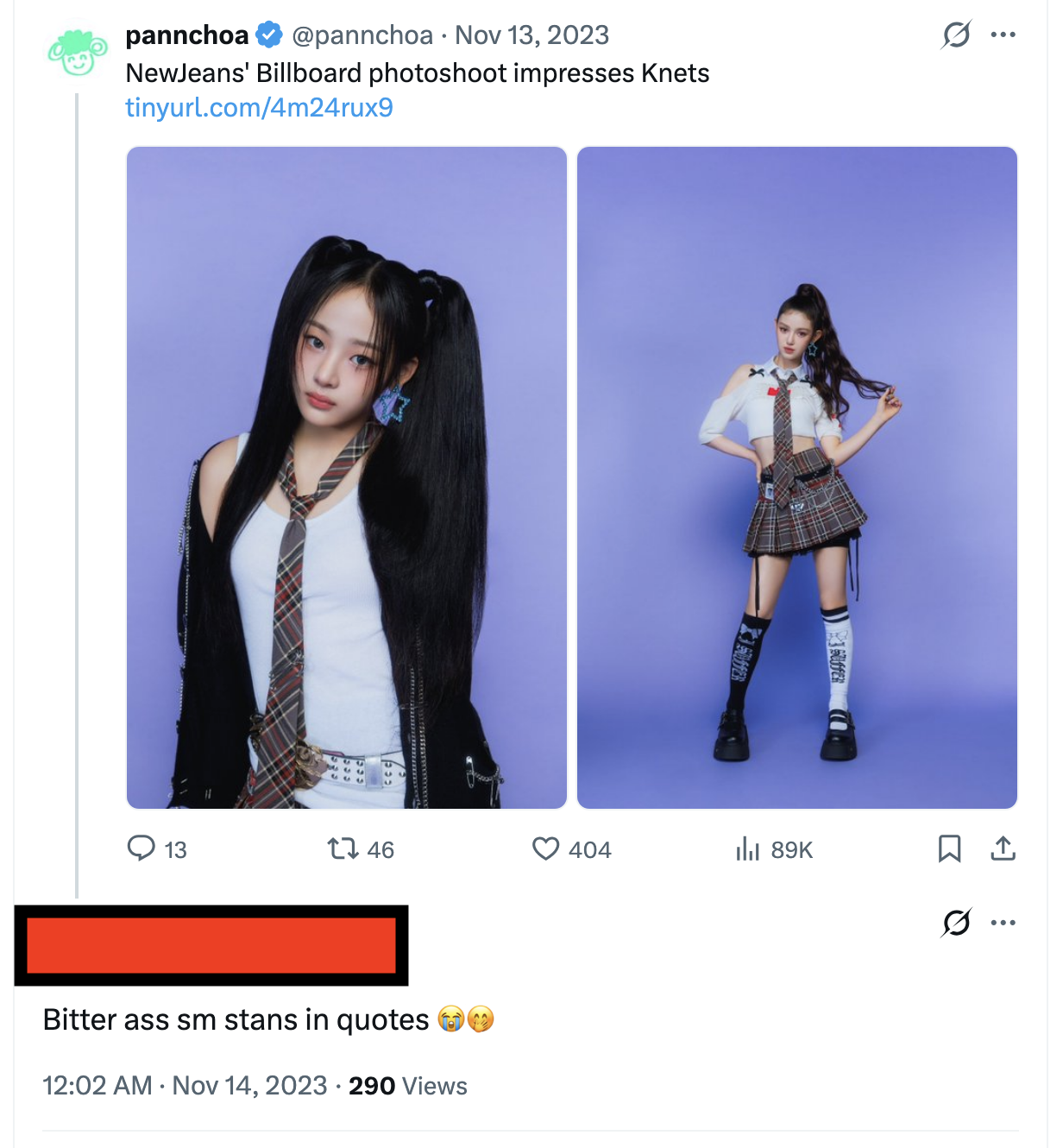
Concerns raised about this at the time of NewJeans debut were dismissed by Hybe fans caught up in the excitement as simply “bitter SM stans.”
When NewJeans debuted, the members' ages ranged from Minji (18), the oldest, to Hyein (14). Knowing Min Hee-Jin’s previous work, I think it’s clear she is leaning into her wheelhouse with NewJeans—which is her fascination with the Lolita character, a coquettish teenage girl acting more mature than she perhaps is. The example I have used in the past was Britney Spears with her schoolgirl plea in “Baby One More Time.” There’s an element of playing with fire that has an undeniable audience appeal, as evidenced by both the lasting legacy of “Baby One More Time” and the incredible reception of “Attention.”
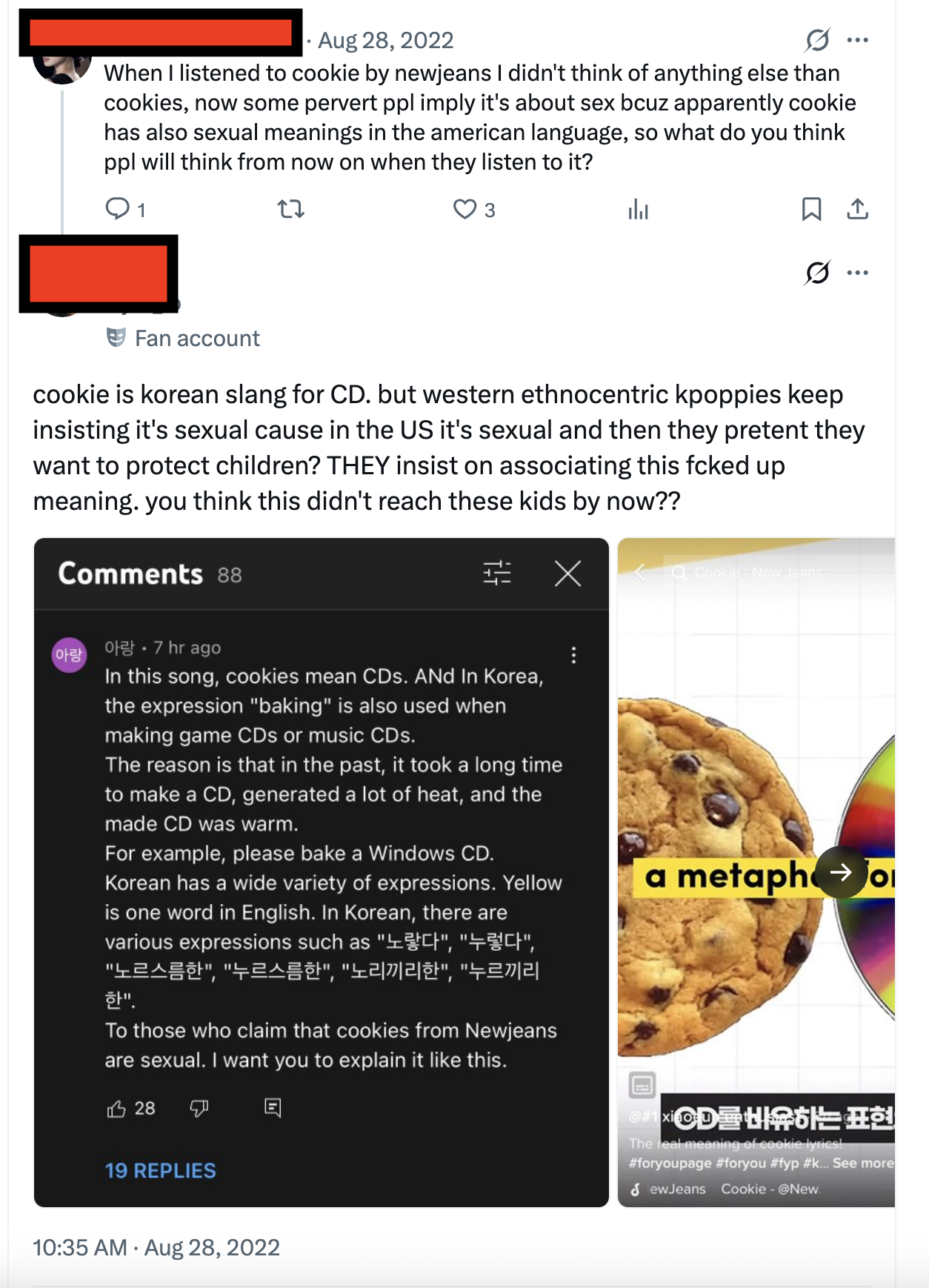
If one was unfamiliar with Min Hee-Jin’s previous work, I think it’s plausible that the Lolita undertones could have been ignored but “Cookie” was a little too on the nose. Is it about baked goods/CDs? You be the judge.
I want to make it clear that I have never seen evidence that Min Hee-Jin herself is a bad actor or allowed harm to come to any of the idols under her care but I do think it’s relevant to go through this because I think Min Hee-Jin both has a proven track record of creating successful branding for idol groups and I think that is why she was hired by then-BigHit Entertainment and it’s relevant that nobody outside of some oldhead K-Pop fans like myself were concerned at the time about teenage girls singing about their cookies.
At this point, and until the infamous press conference given by Min Hee-Jin laying out the dirt on Hybe, the “BTS’s Money” fans were very on board with whatever NewJeans was doing. The concern about Min Hee-Jin’s past work only came after the very public split between Min Hee-Jin and Hybe in April 2024 when she was a liability for the company.
In the New York Times article, it says that this part of the template was left out of the NewJeans contract:
When entering into a popular culture and arts services contract, the ‘Agency’ shall verify the age of the popular culture and arts performer, and shall not demand that a performer who is a minor engage in excessive physical exposure or overly sexually suggestive expression.
MUSIC & ARTIST FOR HEALING
Another angle to the NewJeans contract case is that Hybe has promoted itself as an exceptional company in relation to idols’ mental health and treatment. Hybe artists have even worked on global mental health campaigns for UNICEF. The New York Times article directly contradicts that narrative.
In December 2023, the company even released a series on YouTube exploring their own Training & Development System and how progressive it was followed by the announcement in 2024 of the industry’s first in-house mental health clinic.
In contrast, here is the New York Times article on NewJeans’ mental health conditions:
The Korean government has a K-pop contract template that guarantees the right to education and to physical and mental health. The NewJeans contracts stripped away that language.
And on their training conditions:
Rehearsing until 2 a.m. was not uncommon, according to interviews with people close to the group who spoke on condition of anonymity because of the fear of retribution from the label. Video cameras monitored training areas, and three people close to the group said that taking breaks was discouraged. Four of the five members dropped out of school during training.
When the legal battle with Min Hee-Jin was launched in April 2024, journalists looking into Hybe’s background also uncovered incidents such as the alleged death of a Hybe employee from overwork, which is a serious issue in Korea.
This is not to say that other K-Pop companies do not have labor issues. The internet is littered with articles dating back years discussing the exploitative practices of K-Pop companies. This was a firmly entrenched part of the Dark Side of K-Pop narrative e.g. here’s the Guardian in 2017:
Artists in both territories are often signed up to draconian contracts in their early teens, keeping them tied to specific management companies, such as SM Entertainment. They train in a competitive environment alongside other potential stars, with only the best “idols” making it into the manufactured bands. As well as the aforementioned dating rules, band members’ diets are closely monitored. In 2012, girl group Nine Muses revealed their “paper cup diet”, where their meals had to fit inside a tiny paper cup.
And again in 2019:
Promising stars are put through a gruelling training schedule as they pass along the conveyor-belt production of new girl- and boybands. Young stars are subjected to strict controls over their private lives, including bans on dating, restrictions on mobile phone use and an expectation that they will sacrifice their health to achieve the desired image.
“I think a day where [people] would be ashamed of the K-showbusiness will surely come,” one user wrote. “I think an industry that makes money by [making people] sing, dance, undergo plastic surgeries and go on a diet to please the gaze of others since they are teenagers should really go bankrupt.”
Hybe presented itself as different and a cynical observer may question if they presented themselves as different specifically to counter this narrative. The leaked contract implies that perhaps Hybe was not so different to the other companies after all.
The More Things Change, the More They Stay the Same
What I read in the New York Times article was not shocking to me because I’ve been paying attention in these spaces for a long, long time. It is not surprising that Hybe, allegedly, at best, operates no differently from other K-Pop companies in regards to their idols—who are officially not employees, thanks to a legal ruling against NewJeans member Hanni in November 2024.
What is shocking is seeing fans, in particular the BTS’s Money fans, blaming the members themselves and/or their parents for their treatment. Certainly, the entertainment industry in the USA has its own long history of child star mistreatment and I’ve read more than enough memoirs from former child stars to know that stage parents using their children as workhorses is a real phenomenon.
Whether a young person needs the money, like Sunmi (Wonder Girls), who became a trainee to earn enough to support her family through a hard time, or has overbearing stage parents using them as a workhorse (no comment, iykyk), or is simply a showboat and wants to perform (we love you, Key!), does it excuse companies taking advantage of these young kids with draconian contracts?
These companies will say, yes, because they put in the money into their training and later in their careers as an investment and want to make a return on it. Idols are a product, not people (and, again, definitely not employees, legally). Is that the only way? If previous contract disputes changed nothing, then I don’t hold any illusions that this one will either. And certainly nothing will change as long as a strong contingent of fans are willing to handwave away concerns or put the blame on the idols themselves to ensure that nothing interrupts the flow of product.
Exploitative parents are not mentioned but I will note that they are endemic in entertainment.
Especially since TXT’s debut clearly didn’t do what BigHit Entertainment wanted because the kids were sent back to the basement only to emerge months later with both a brand new look and sound. I remember being disappointed at the huge direction shift since I was quite taken with the cutie-patootie teen pop of their debut and much less so the warmed over HYYH redux of the follow-up, where the TXT members appeared to be deliberately styled to look like a mini-BTS rather than themselves. The group, in my opinion, has since been placed on Hybe’s back burner but I always check out their releases. I quite enjoyed this year’s Japanese-language song セツナハナビ.
To my knowledge, Taemin hasn’t spoken on how he felt being sexualized at such a young age but he did put out this MV for the song, “Guilty.”