“This isn’t a group project.”
“Who controls the past controls the future. Who controls the present controls the past.”
George Orwell, 1984
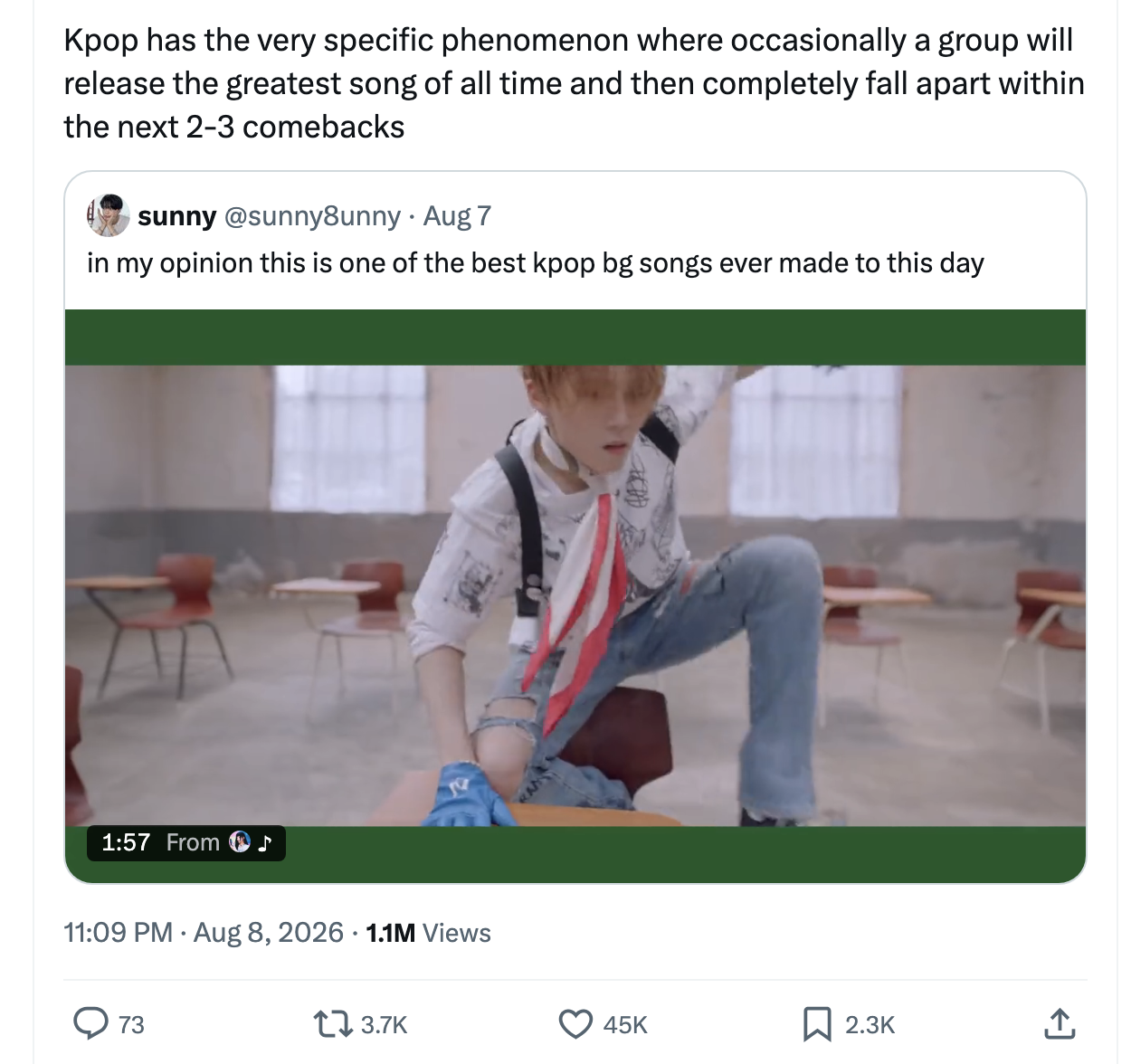
Recently, a post lamenting Pentagon’s disappearance went viral on K-Pop Twitter and left me feeling nostalgic for circa 2018 K-Pop. It doesn’t feel all that long ago to me but the K-pop landscape is completely different now. And it’s different in a way that means the history of that era of K-Pop has been essentially wiped clean in English language spaces.
The biggest song of the year, by miles and miles, was… (no, not anything by BTS, despite what you may have been told) it was “Love Scenario” by iKon.
On the Korean Circle (nee Gaon) chart, alongside “Love Scenario,” it was Momoland’s “Bboom Bboom,” Mamamoo’s “Starry Night,” BigBang’s “Flower Road,” and BlackPink’s “Du Du Du Du.”
But by 2018, what the Korean public is listening to and “K-Pop” have already diverged but what K-Pop fans are listening to, globally, is still more or less the same.
The Kings of K-Pop fandom in 2018 were Wanna One and anyone who tells you differently didn’t live through this era. To be fair, 2018 was admittedly the downward slope of their 2017 dominance but their fans still had enough juice to force flight delays and rack up music show wins.
Along with the previously mentioned broadly popular acts, looking at music show wins, other acts with big active K-Pop fandoms were veteran groups EXO and SHINee along with Twice, Winner, Red Velvet, GFriend, Apink, and GOT7… and, especially, yes, BTS whose fandom was on the rise in this year, in part thanks to a crossover with what Monia and I refer to as the free-floating BL fans, whose primary interaction with fandom is fanfic.
One of the things that was still present in 2018 but that has almost completely vanished now, was the presence of K-Pop bloggers reviewing music. These weren’t the big industry publications who have include enough content from big companies and acts with big fandoms, just regular bloggers. (One of the few left standing is the Bias List for reviews, along with Kpopalypse and Asian Junkie.) The turnover from writing to video went hand in hand with the change from reviewing to reacting in this space.
And “Shine”wasabsolutely mentionedon a variety of lists.
But what struck me more than anything else was the wide variety of acts that were mentioned, there was a lot of depth in the level below the large fandom behemoths like Wanna One. Not just variety as in there were a lot of groups, but variety in that they were all doing different things, musically and performance-wise.
For boy groups, my wheelhouse, there’s not just Pentagon, but you had groups like Astro, Nu’Est, the Boyz, Seventeen, Golden Child, Day6, MonstaX, etc. all making appearances on best of lists of regular K-Pop listeners with a wide variety of songs, despite not having large enough fandoms to rank in on charts or win music shows. MonstaX had a hard edge, the Boyz were cutesy teenybop, Astro had just pivoted from cutesy teenybop to sweet sounding pop, Day6 did rock music, etc. etc. And that’s on top of the variety you were getting from the more prominent acts. SHINee had just released a triple album, concept album with a tropical house banger as the title track. Winner’s “Everyday” played with chilltrap and EXO had the slinky “Love Shot” that went viral around K-Pop spaces for Kai’s red suit.
And it’s important to note here that this isn’t what the current lore tells you: Big 3 dominance where? The truth is that the “Big 3 dominance” was always more marketing ploy than reality. Midsize agencies can and were able to compete against the Big 3 just fine in this era.
But something that is true and rarely talked about is that the period centering on 2018 saw a purging of the biggest boy groups from the field.
2PM went on hiatus in 2017.
BigBang went on hiatus in 2018.
Block B went on hiatus in 2018.
Highlight (nee Beast) went on hiatus in 2018.
Infinite started enlistments in 2018.
Vixx went on hiatus in 2018.
B1A4 went on hiatus in 2018.
BtoB went on hiatus in 2018.
WannaOne disbanded at the end of 2018.
SHINee would start their hiatus at the end of 2018 with Onew’s enlistment.
EXO would start enlistments in 2019.
These were all acts with significant, if not huge fandoms.
In theory, going on what happened in the past, the gap in the field should have led to the growth of another crop of large and varied acts. And we did start to see the seeds of that happen. Astro—who I will never stop singing the praises of—got their first and very emotional music show win in January 2019. Seventeen also absolutely surged in popularity in 2019, with their album An Ode. MonstaX was doing really well in 2019 and you also had the mega debuts of X1 and Ateez. And SM’s NCT was finally gaining some traction (thanks in part to SuperM, which is a hill I will die on.) Winner was also huge in 2019, with member Mino even having a massive hit with “Fiance.”
So, why is it with this massive variety of boy groups with large and growing fandoms who had been left an essentially an empty playing field, BTS took home basically every award for the next few years and dominated K-Pop conversations in English while songs like Pentagon’s “Shine” which were quite popular among K-Pop fans globally at the time have become essentially deep fandom lore shared on X instead of entering the English-language K-Pop fan canon?
Well, let me tell you my theories.
1. English-language fandom got a massive influx of BTS fans beginning in 2016-17. It started with a small trickle but became a flood leading up to “Dynamite” and then exploded. These new fans came from a few sources, none of which were traditional K-Pop fandom demographics: One Direction fans and other boy bands looking for a fix, the aforementioned free floating slash fans (many of whom are now currently in Heated Rivalry fandom), and moms brought in by mainstream entertainment, many of whom were experiencing Baby’s First Fandom.
While these demographics weren’t proportionally huge on their own in the United States or other Anglosphere countries, it was enough to absolutely swamp the existing global K-Pop marketplace, which responded to the economic incentives in predictable ways, especially as the pandemic kicked in and these new BTS fans were willingly acting as unpaid bot labor, streaming, buying, and streaming and buying songs like “Dynamite” and “Butter.”
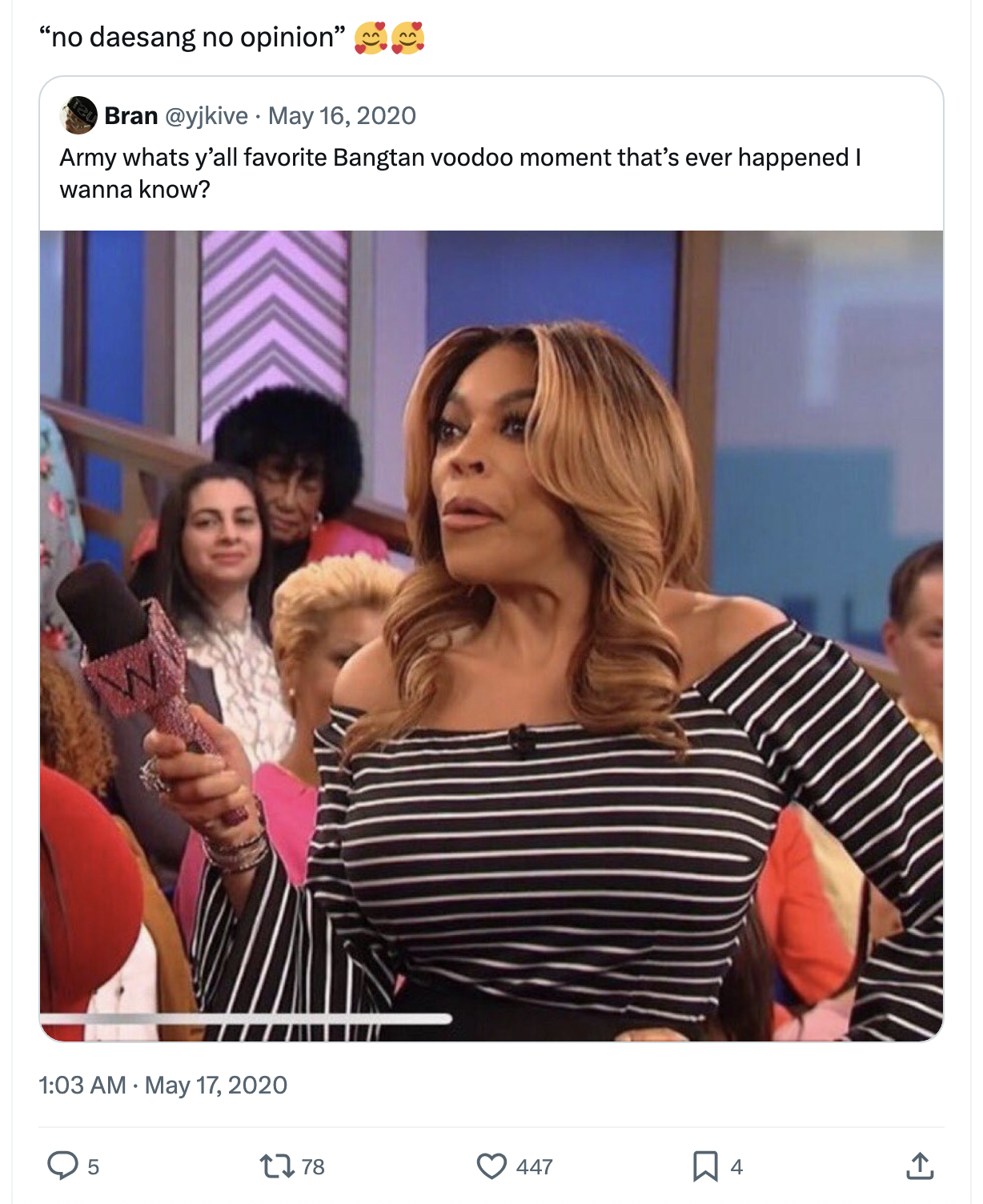
All of this unpaid fan labor and new focus on the American market helped to build a very expensive new K-Pop arena. Now, companies needed to generate not 100,000 copies or even 500,000 copies (which would have been a mega-blockbuster album in 2015) but by 2018, the bar had been raised to the million level for a hit album and it kept rising. There are huge upfront costs involved in that—let alone some of the alleged shenanigans like selling albums at an upfront discount to bulk buying fan groups, among others. The same for streams. 500 million on YouTube or risk being called a flop. Fans can’t generate that all on their own and various streaming sites, it also takes cash money. And don’t forget touring. Instead of Korea-Japan-Taiwan-China-SEA, acts were expected to hit more American dates and in bigger and bigger venues. That takes money up front. Even things like music show appearances, which are expected from K-Pop acts, can be costly. Let alone things like awards, which were fandom bragging currency. No daesang, no opinion.
The upshot of this, in my opinion, is that it became prohibitively expensive to participate in the K-Pop marketplace for all but the biggest of big companies. And even for the big companies, that mean sticking to “safe” output—too expensive to experiment now. That healthy midtier of groups was basically wiped out. It has become such a problem that the Korean government finally stepped in this year to offer financial assistance to smaller agencies. Presumably, even they are tiredof thecurrentofferings from the dominant company and want to give groups like Rescene (from label the Muze) a leg up.
2. The BTS exceptionalism narrative fed to the new incoming, outside fans may have done great things for BTS (and their company) in the short term but, in my opinion, the long term effects have been brutal for both BTS and the industry itself. I’ve often talked about how “BTS paved the way” is very much a thought terminating cliche and means nothing but here’s the nuance: they absolutely did pave the way to the current and very stale state of K-Pop.
For one thing, I like to talk about the K-Pop trend generator. That trend generator is currently running on fumes and skibidi toilet music. For years, K-Pop worked by filtering concepts down from the top acts, where they’d get adapted by others in a very Korean trend cycle. E.g. Boy groups in the style of BigBang were the template for years and everyone wanted their own nasal-voiced, self-producing rapper a la G-Dragon… until they wanted a Zico from Block B. Kai from EXO went viral and then everyone wanted a hunky main dancer… until they wanted something else. It sounds formulaic, and to an extent it is, but just because an idol was cast “in the mold of” an idol like G-Dragon, didn’t mean that the idol wouldn’t eventually form their own identity. I would argue that E’Dawn from Pentagon was in this category.
The problem with the K-Pop trend generator is that it needs artistic input. BTS provided none—they had spent their careers downstream of acts like VIXX, BigBang, BAP, Block B, SHINee, EXO, etc. With BTS dominating the K-Pop scene, the trend generator for boy groups had nothing to feast on except maybe bubblegum concepts and over compressed, autotuned vocals—which, to be fair, when done as a “concept,” by a talented group could be made palatable.
Instead of anything artistic trickling down the generator, what’s trickled down is the focus on sales, streams, and charts, etc.
3. And then there’s the very specific BTS-exceptionalism narrative that meant that a large swathe of these incoming fans were (at least initially) unreceptive to anything other than BTS. This is the origin of the (now forgotten?) “multi is a slur in Korea” mythos. While it is true that in Korea fans may have stuck to one group or another, global fans and especially English-language fandom had tended to support numerous groups. In Korea, fans would have a lot of opportunities to see media, as well as to engage with in-person support and events that just weren’t available for foreign fans. So, by necessity, foreign fans, generally, engaged with content from a lot of groups when engaging with K-Pop. This meant that when a K-Pop group would tour in your country—no matter which group—K-Pop fans would turn out to see them. The downside of this was that if another group you liked better announced their concert a few months later, fans may not have had the money to attend a second concert. So oversaturation of the relatively small global K-Pop marketplace was a real problem… and still is, in my opinion.
Even BigHit Entertainment, BTS’s company, tried to interest BTS fans in TXT in 2019 when they debuted, but it didn’t work. Despite BTS having been around for six-seven years at that point, the newer fans who had just discovered the concept of K-Pop were still caught up in the initial buzz of BTS and wouldn’t budge…yet.
(Now, here we are six-seven years past when these new fans joined and we are seeing that cohort of BTS fans—what is left of them—spreading out and taking their bad habits with them.)
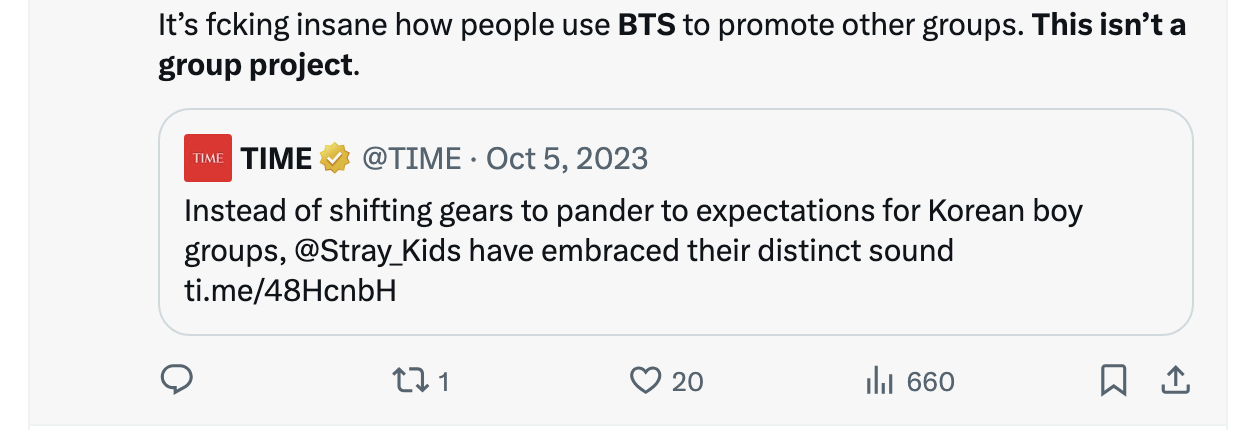
BTS fans were quick to say “this isn’t a group project,” meaning that they didn’t have any obligation to take any interest in the history or broader context of K-Pop. Sure, okay. But removed from the broader history and context of K-Pop, BTS makes no sense. It’s like taking a fish out of water and expecting it to fly. I flagged this as early as 2018 when I was a new BTS fan, but I was coming from an Asian pop fan context. And I think my predictions have come true.
In isolation, BTS wasn’t coming from a rich musical and pop culture history with its own references and touchpoints. They became, essentially, Menudo Redux, singing about drinking milk with King Kong and being smooth like butter.
What happened to Pentagon is a little different from the doldrums of a group like MCND. Pentagon lost key member E’Dawn in a dating scandal in 2018 and never really bounced back.
Some of these groups (and idols) that might have at one point existed as part of the healthy midtier, tried their luck with competition shows like Road to Kingdom but even the Produce series that gave us Wanna One got taken out in 2019 by a voting scandal and the series never bounced back. Other rising groups (conveniently, coincidentally?) lost key members in this key era—NCT’s Lucas, MonstaX’s Wonho, and iKon’s B.I. among them. Woodz seems to have been the only large mainstream artist to really emerge from the boy groups of this era.
I hope this is starting to change… the girl group scene, at least, has bounced back from the NewJeans-pocalypse and showed signs of wanting to engage with the genre’s own history.
It’s been really refreshing to see Rescene bounce onto the scene and with a throwback to classic girl group KARA and former IZ*One idol Yena has also had a retro-themed hit with “Catch Catch”.
Over in Japan, when Johnny’s & Associates (now STARTO) was taken out, the boy group midtier exploded and although Snow Man is still the dominant group (for now), the rise of formerly low-to-midier M!LK to the upper echelons of J-Pop has been wonderful to watch.
I’d love to see the same thing happen in K-Pop but you need the midtier groups to do so… maybe a LNGSHOT?