“Trust Me, I’m Being Persecuted”
Before Ryan Holiday got into the self-help game, he wrote a fascinating book about his time in public relations called Trust Me I’m Lying. The book discusses marketing strategies for the online age—well, the online age of 2010s. While some things are now dated (RIP Gawker) other tactics are alive and well.
One of the things discussed in Holiday’s book is the fact that negative information holds our attention so much better than neutral or even positive information. This stirring up of negative emotions can be spun into what we may as well call Persecution Marketing, a phrase I’ve seen used in Christian media but I think is a very handy descriptor of a tactic I’ve been seeing in K-Pop.
Here is persecution marketing at work, as described by the American Conservative:
Costco pulled D’Souza’s new book off its shelves a month into its run, claiming poor sales. D’Souza cried foul, saying it must be because the company’s former CEO gave money to Obama, and Obama has had good words to say about the company. The story went viral on conservative media, and the D’Souza book became an Amazon bestseller … which resulted in Costco putting the book back on its shelves.
Pretty neat little marketing trick! Gin up your base by claiming you’re being persecuted and then sit back and let the money and unpaid positive PR roll in as they rush to defend you.
To properly use Persecution Marketing, you need to create the Persecutor. This can be done by fandom amplifier accounts whipping up stans into a frenzy to attack a specific target. These targets can be fellow fans, journalists, random online netizens, basically anyone. Like the people in the example sticking it to Obama by buying D’Souza’s book, it doesn’t matter to the frenzied stans whether or not the accusations against the target are true or untrue or even relevant, only that they have been made and that they fit into a narrative of persecution.
The most recent example I’ve seen online began with amplifier accounts directing stans to attack writer Leah Bess for her column at the Needle Drop on BTS’s “Swim.” I’m not too familiar with Bess’s work but the column seems to be an answer to Tom Breihan’s Number Ones looking at the dregs of Billboard Hot 100. Like Breihan, she compiles sources and quotes from industry publications to tell the story of “Swim.”
Here is Bess in her column:
“SWIM” was written by nine people at the LA songwriting camp, spearheaded by OneRepublic frontman and pop machine stalwart Ryan Tedder. Under his wing were ghostwriters Kirsten Spencer, Derrick Milano, and James Essien, 3OH!3’s Sean Foreman, producers Tyler Spry and Pdogg, and Diplo collaborator Jamison Baken (Diplo himself contributed significantly to ARIRANG).
In press materials, the song was attributed to BTS member RM, who said “I wrote the lyrics and I tried to express the confusion that we all had before [and] after the military... and we want to just keep swimming.” This is not true. According to Spry, the process was more like this: “That day, we were paired with [producer] Leclair, who’s signed to Diplo. When we were working, we’d write two or three songs because we weren’t trying to deliver a finished, polished thought. There weren’t any references. Leclair and I just put together the rough beat while James and Sean were freestyling on the couch. The chorus just fell out of thin air.”
The juxtaposition of the marketing materials and the industry quotes is brutal.
But stans are very good at ignoring things they do not want spread around. While a few stans may have read this and been annoyed, the Needle Drop is not a publication read by large numbers of BTS stans and it may well have passed unnoticed except that a new persecutor was needed to rile up the troops and their chosen offense was the Persecution Narrative that has been used throughout this current BTS album cycle for Arirang: BTS’s Korean identity.
The idea is that critics like Pitchfork’s Joshua Minsoo Kim aren’t giving Arirang middling reviews because the album is mediocre, it’s because something-something BTS’s Korean identity is being attacked!
Here are some replies to Bess’s post on the article on X:
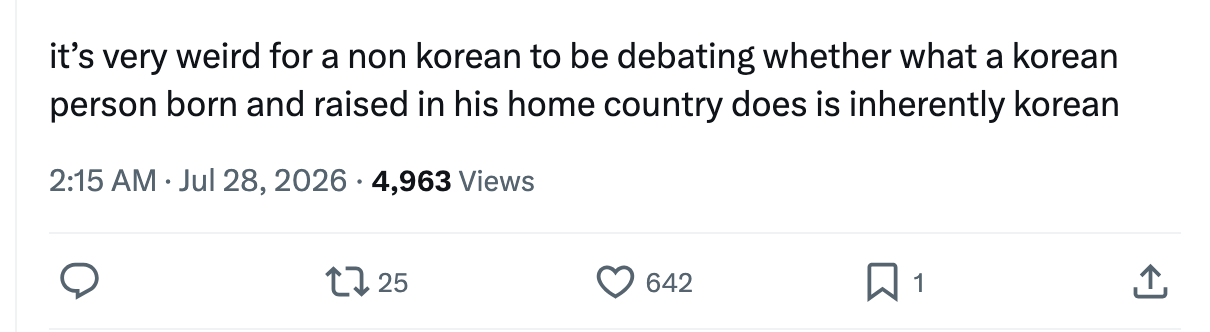
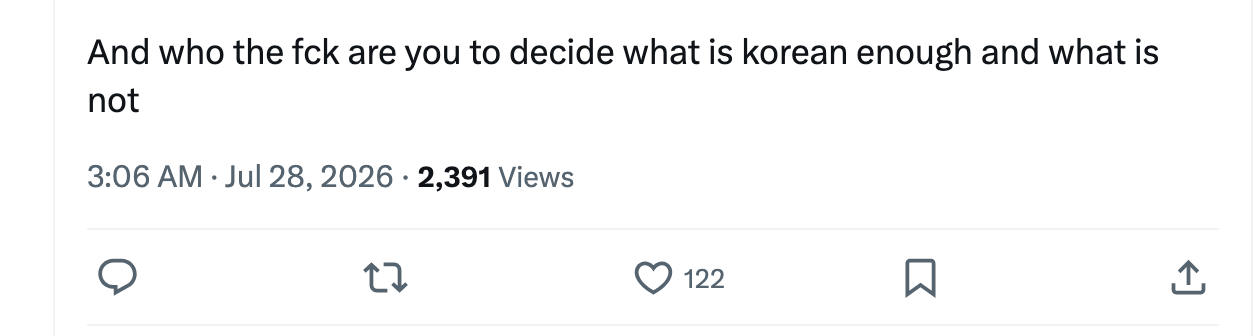
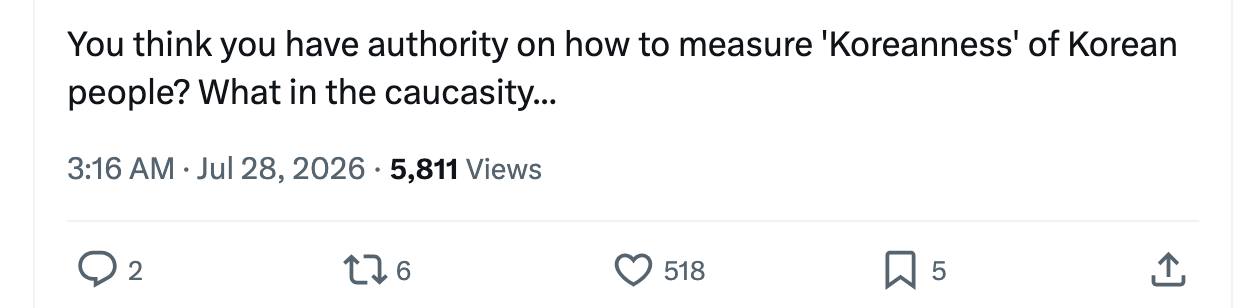
It doesn’t matter that nothing in Bess’s article had anything to say about BTS’s Korean identity re: “Swim” and how that played into the quality of the song (a mediocre song about nothing). All they needed was a couple of lines they were able to twist out of context to fit the chosen Persecution Narrative regarding identity.
The article dropped on July 27 but the attacks didn’t get going until the 28th which laid the perfect ground for BTS to drop their announcement that they weren’t submitting for the Grammys on the 29th into a fandom primed to feel persecuted over identity.
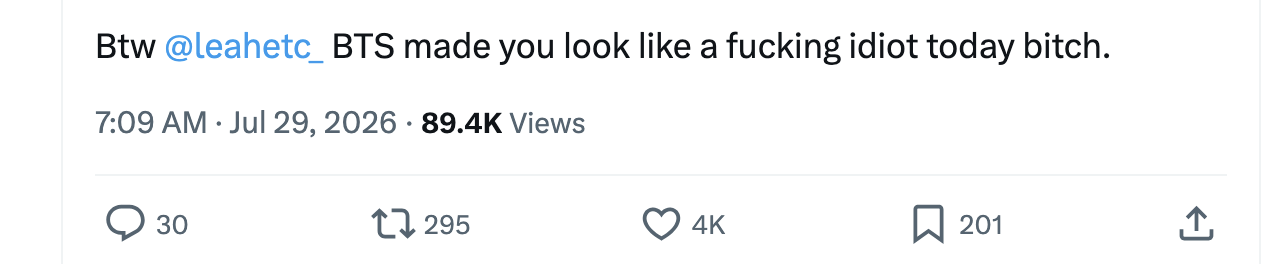
(Grammy was not mentioned anywhere in Bess’s post but that doesn’t matter in Persecution Marketing.)
It’s the perfect Persecution Marketing rollout for BTS to hit America’s largest media market in New York with their Arirang tour this weekend, giving outlets a reliable hook for any potential stories. Now it’s not Lame Boy Band Shuffles Into Stadium After a Floptastic World Cup Halftime Show, it’s Brave Social Justice Warriors Stick It To the Grammys.
I have already written on the ridiculous “Asian Pop” category and won’t repeat myself here but I will say that multiple things can be true at once:
the “Asian Pop” category is poorly thought out and feels like a giveaway for K-Pop acts,
the Grammys has an unfortunate history of racial slicing and dicing of categories to protect the interests of powerful industry cliques,
the Grammys have long given boy bands and male vocal groups short shrift, and
Arirang was simply not very good which meant it wouldn’t have won in the major categories and, unfortunately, seems to have been ineligible for the Asian Pop award.
If Grammy isn’t awarding *NSYNC, who could actually sing and dance, why would they award BTS?